Mandalas and Modules
Epilogue
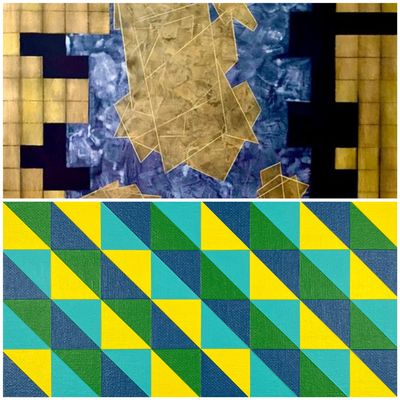
At the midpoint of the run of the online exhibition, Mandalas and Modules, it may be appropriate to consider the ways in which the visual concepts in the show relate to time and culture. Mandalas appear in various spiritual traditions, while modules seem to echo a more contemporary and technological perspective. But can mandalas still be relevant today, and can we find the forms of modules throughout history? As a tool for improving attention and achieving focus, the mandala may be particularly helpful in this current age in which people are increasingly distracted by digital media. At the same time, modules or grid-like compositions have been motifs in the crafts of many ancient civilizations, from weaving to pottery, from hieroglyphs to mosaics. Seen in this light, mandalas and modules are not contradictory but rather complementary. Furthermore, the tension between unity and diversity, singleness and repetition, the one and the many, can be creative. So what are some examples of psychological mandalas and modules that can be combined to produce balance and generate growth in people’s lives? Obsessions can be controlled with good habits, otherwise they become unhealthy. Also, personal values prevent everyday responsibilities from feeling monotonous. Basically, vision and diligence are both necessary for innovation. If there is a moral to the narrative set up in this virtual abstract painting show, this one is as possible as any. The artworks in Mandalas and Modules are not disconnected from philosophical problems or social concerns, even if Ron Hartgrove and Luc Sokolowski do not always consciously intend them to refer to such issues. Since they already live and work within social, cultural, historical, and intellectual contexts, their art cannot help but be applicable and meaningful to discourses about them. It is up to the viewer, however, to make these relatively implicit relationships more explicit for themselves.